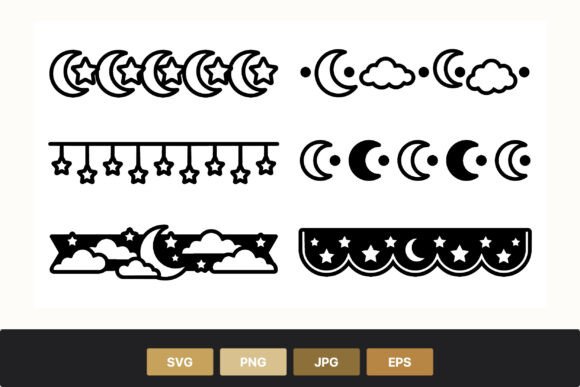
Moon Star Cloud Line Art Border: A Strategic Asset for Visual Communication
In the crowded landscape of digital and print media, the choice of visual elements is rarely just an aesthetic decision; it is a strategic one. The Moon Star Cloud Line Art Border represents more than a collection of decorative lines. It is a versatile design system rooted in the timeless imagery of celestial bodies and atmospheric elements, rendered in a disciplined black and white vector format. For professionals ranging from brand managers to independent creators, understanding how to deploy this specific style can significantly impact clarity, production efficiency, and overall brand perception.
The essence of this asset lies in its flat line style. By stripping away gradients, shadows, and complex textures, the design forces the viewer to focus on form and composition. When you integrate a Moon Star Cloud Line Art Border into your workflow, you are selecting a tool that prioritizes scalability and neutrality. This makes it particularly effective for projects requiring a sophisticated yet unobtrusive frame, such as educational materials, wedding stationery, or corporate annual reports where the content must remain the undisputed focal point.
The Strategic Value of Minimalist Celestial Imagery
Why choose a border featuring moon crescent phases, stars, clouds, and garlands? The answer often lies in the psychological resonance of these symbols combined with the practical benefits of the line art medium. Celestial imagery evokes themes of cycles, growth, mystery, and continuity. When arranged as borders and decorative rows, these elements create a sense of enclosure and protection without feeling heavy or oppressive.
For entrepreneurs and marketers, the strategic value extends beyond symbolism. The black and white vector nature of the Moon Star Cloud Line Art Border ensures universal compatibility. Unlike raster images that degrade when resized, vector formats maintain crisp edges at any scale. This technical reliability translates directly into cost savings and time efficiency during the production phase. You do not need to worry about pixelation when a small social media graphic needs to be blown up for a large banner or vice versa.
Furthermore, the inclusion of garlands alongside the celestial elements introduces an organic, flowing counterpoint to the geometric precision of stars and moons. This balance between structure and fluidity allows the design to adapt to various tonal requirements. A business seeking to project stability can emphasize the structured rows of stars, while a creative agency might lean into the whimsical flow of the cloud and garland arrangements. The flexibility inherent in the design allows for intentional positioning rather than random decoration.
Optimizing Workflows with Multi-Format Deliverables
A critical component of making better decisions in design procurement is evaluating the utility of the file formats provided. The download package for this asset is structured as a compressed ZIP file, bundling SVG, PNG, EPS, and JPG formats. This variety is not merely a convenience; it is a strategic enabler for diverse production workflows.
- SVG (Scalable Vector Graphics): Ideal for web developers and UI/UX designers. The code-based nature of SVGs allows for direct manipulation of colors and paths within CSS or JavaScript, ensuring the Moon Star Cloud Line Art Border remains lightweight and responsive across all devices.
- PNG (Portable Network Graphics): Essential for quick mockups and presentations where transparency is required. The high-resolution PNGs allow you to overlay the border onto photos or colored backgrounds without the need for vector editing software.
- EPS (Encapsulated PostScript): The industry standard for professional print applications. If you are working with offset printers or preparing files for large-scale signage, the EPS format ensures that the intricate details of the crescent phases and garlands are preserved with absolute fidelity.
- JPG (Joint Photographic Experts Group): Useful for standard image compatibility in email newsletters or legacy systems that do not support vector formats.
By having access to all these formats simultaneously, you eliminate the friction of conversion. Time saved on file preparation is time redirected toward strategy and execution. This comprehensive approach supports a seamless transition from concept to final output, whether the end goal is a digital campaign or a physical product launch.
Intentional Application in Branding and Operations
Using the Moon Star Cloud Line Art Border effectively requires a clear understanding of your communication goals. Randomly applying decorative borders can clutter a layout and dilute your message. Instead, consider the border as a framing device that guides the reader's eye and establishes a hierarchy.
In branding, consistency is key. If your brand identity relies on clean lines and a monochromatic palette, this asset integrates naturally. However, if your brand is defined by bold, saturated colors, using a black and white line art border can provide a necessary visual rest area, preventing sensory overload. It acts as a neutral container that allows your primary content—be it text, photography, or data visualization—to stand out.
For educators and publishers, the use of these borders can enhance readability and engagement. A row of stars and clouds at the bottom of a page can serve as a subtle footer, separating content sections without the harshness of a solid line. In educational materials, the familiar imagery of the moon and stars can create a comforting, engaging atmosphere for learners, making complex information feel more accessible.
Small business owners should also consider the operational implications. Having a library of pre-designed, high-quality assets like this reduces reliance on external freelancers for every minor design tweak. You gain autonomy over your visual output, allowing for rapid iteration and testing of different layouts. This agility is crucial in fast-paced markets where speed to market can determine success.
Risks of Contextless Implementation
While the versatility of the Moon Star Cloud Line Art Border is a strength, it also presents risks if used without a strategic framework. The most common pitfall is the "decoration trap," where design elements are added simply because they look nice, rather than because they serve a function. Over-decorating a document with multiple borders, garlands, and star rows can make the content appear amateurish and difficult to navigate.
Another risk involves tonal mismatch. While celestial imagery is generally positive, it carries specific connotations. Using a whimsical arrangement of clouds and moons in a serious financial report or a somber legal document could undermine the gravity of the content. Decision-makers must evaluate whether the emotional tone of the border aligns with the message being conveyed. If the context demands strict professionalism, a simpler geometric border might be more appropriate than one featuring playful garlands.
Furthermore, relying solely on pre-made assets without customization can lead to a generic look. Many users may have access to similar line art collections. To maintain a unique brand voice, it is advisable to modify the color palette, spacing, or density of the elements. The SVG and EPS formats included in the package facilitate this level of customization, but only if the user has the intent and skill to apply them.
Planning for Long-Term Visual Consistency
To maximize the long-term value of the Moon Star Cloud Line Art Border, incorporate it into a broader visual identity system. Treat the border not as a standalone element, but as a modular component of your brand's design language. Define guidelines for when and where it should be used. For example, specify that the full border is reserved for cover pages, while a simplified row of stars is used for section dividers.
This planning ensures that every piece of communication, from a business card to a website header, feels cohesive. Consistency builds trust with your audience. When clients or customers recognize your visual patterns, they associate those patterns with your quality and reliability. The scalable nature of the vector files means this consistency can be maintained indefinitely, regardless of changes in technology or print methods.
Consider the lifecycle of your projects. A well-chosen border style can age gracefully, unlike trendy graphics that quickly become dated. The classic combination of moon, star, and cloud motifs has remained relevant for centuries. By anchoring your design in these timeless elements, you protect your brand investment against the rapid shifts of design trends.
Decision-Making Framework for Design Assets
Before integrating the Moon Star Cloud Line Art Border into a new project, ask three strategic questions:
- Does this element support the primary message? If the border distracts from the core content, it fails its purpose.
- Is the format compatible with my production pipeline? Ensure you have the necessary software to edit the SVG or EPS files if customization is required.
- Does this align with my brand's emotional tone? Verify that the whimsy of the garlands or the calm of the moon phases matches the intended audience reaction.
By answering these questions, you move from passive consumption of design assets to active curation. This shift empowers you to make decisions that drive results rather than just filling space. The Moon Star Cloud Line Art Border is a powerful tool, but like any tool, its effectiveness depends entirely on the hands that wield it and the strategy behind its use. With thoughtful planning and intentional application, it can elevate your work, streamline your operations, and reinforce your professional standing.