Intricate Black and White Mandala Circle: A Practical Guide to High-Contrast Vector Art
In the realm of graphic design and digital illustration, the Intricate Black and White Mandala Circle represents a specific aesthetic and functional category. This style is defined by its reliance on geometric precision, radial symmetry, and the stark visual impact of monochromatic contrast. Unlike colorful or gradient-based designs, this approach strips away hue to focus entirely on line weight, pattern density, and structural balance. When evaluating resources for projects requiring sharp, scalable graphics, understanding the distinct characteristics of this style is essential for making an informed decision.
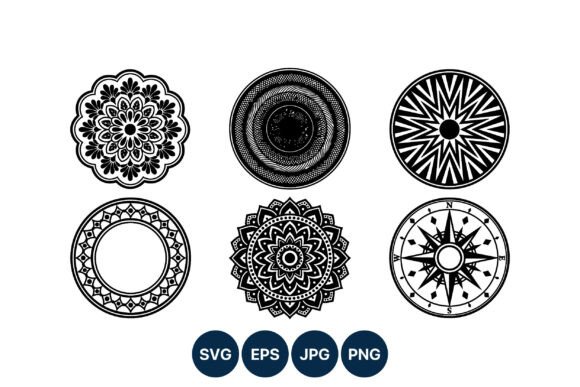
The core appeal of an Intricate Black and White Mandala Circle lies in its versatility and technical robustness. These designs often feature complex interlocking patterns that create a sense of depth and movement without relying on color theory. The inclusion of elements like a detailed compass rose within a set of six circular designs further expands the utility, bridging the gap between decorative art and navigational symbolism. For professionals and hobbyists alike, the choice to utilize these specific assets depends heavily on the intended medium, the need for scalability, and the desired visual tone of the final output.
Defining the Visual Language of Monochromatic Mandalas
To understand why the Intricate Black and White Mandala Circle stands out, one must first examine its construction. The term "mandala" originates from Sanskrit, meaning "circle," but in modern design, it refers to any composition that radiates from a central point. When rendered in black and white, the design relies on the interplay of positive and negative space. This creates a high-contrast effect that is immediately legible, even at small scales.
What makes this specific collection distinct is the combination of organic mandala flows with rigid geometric structures, such as the compass rose. While traditional mandalas often evoke spiritual or meditative themes through floral and abstract motifs, the addition of a compass rose introduces a nautical or cartographic element. This hybridization allows the artwork to serve dual purposes: it can function as a purely decorative background or as a thematic icon for travel, exploration, or orientation.
The vector nature of these files is a critical component of their definition. Unlike raster images composed of pixels, vector graphics are mathematically defined paths. This means an Intricate Black and White Mandala Circle can be scaled from a tiny favicon to a massive billboard without any loss of quality. The lines remain crisp, and the edges stay sharp, ensuring that the intricate details do not blur or pixelate. This technical attribute is what separates professional-grade vector assets from standard downloadable clipart.
Comparing Vector Formats and File Flexibility
When selecting digital art resources, the file format is often as important as the visual design itself. A comprehensive download package typically includes a ZIP folder containing SVG, PNG, JPG, and EPS files. Each format serves a different purpose, and understanding these differences is vital for effective project management.
- SVG (Scalable Vector Graphics): Ideal for web use and screen displays. SVG files are lightweight and code-based, allowing them to scale infinitely while maintaining perfect clarity. They are also editable in most vector software.
- EPS (Encapsulated PostScript): The industry standard for print production. If you intend to send your design to a professional printer for large-format signage or packaging, the EPS version of the Intricate Black and White Mandala Circle ensures compatibility with prepress workflows.
- PNG (Portable Network Graphics): Best for digital overlays where transparency is required. PNGs support transparent backgrounds, making them suitable for layering over photos or colored backgrounds in photo editing software.
- JPG (Joint Photographic Experts Group): Useful for quick previews or social media posts where file size is a concern, though they lack transparency and are resolution-dependent.
Comparing this multi-format approach to single-format alternatives reveals a significant advantage in workflow efficiency. Many free or low-cost resources offer only a single JPG or PNG file, limiting the user to a fixed resolution. If a designer needs to enlarge that image for a poster, the result will be blurry. In contrast, the availability of both SVG and EPS formats within the same package provides the flexibility to adapt the Intricate Black and White Mandala Circle to any dimension without compromising quality.
Evaluating Use Cases and Design Applications
The decision to use an Intricate Black and White Mandala Circle should be driven by the specific requirements of the project. Its high-contrast nature makes it particularly effective in situations where clarity and boldness are paramount. However, it may not be the optimal choice for every design scenario.
Ideal Scenarios for Implementation
This style excels in applications requiring strong visual anchors. For instance, in logo design, the radial symmetry of a mandala can convey stability and unity. The black and white palette ensures the logo remains recognizable across various mediums, from embossed business cards to embroidered uniforms. Similarly, in tattoo art, the high contrast translates well to skin, where fine lines need to remain distinct over time. The vector format allows artists to adjust the line thickness to suit different body areas.
Print-on-demand products also benefit significantly from these assets. T-shirts, mugs, and tote bags often look best with bold, graphic prints. The Intricate Black and White Mandala Circle provides a sophisticated alternative to busy, multi-colored illustrations. The simplicity of the two-tone scheme allows the product's base color to complement the design rather than compete with it.
Limitations and Trade-offs
Despite its strengths, there are trade-offs to consider. The primary limitation is the lack of color. Projects that require a vibrant, playful, or emotionally nuanced palette may find the monochromatic restriction too severe. Additionally, the intricate detail of these mandalas can sometimes overwhelm smaller spaces if not managed correctly. On a very small mobile interface, the complexity of a detailed compass rose might become indistinguishable noise unless simplified.
Furthermore, the "high-contrast" characteristic, while visually striking, can be harsh in certain contexts. Designs intended to be subtle, soft, or background-oriented might clash with the aggressive visual weight of solid black lines against white. In such cases, a watercolor texture or a softer, lower-contrast illustration might be a more appropriate alternative.
Decision Factors for Selecting the Right Asset
When comparing the Intricate Black and White Mandala Circle against other design resources, several factors should guide the final decision. First, consider the scalability requirement. If the project involves resizing the image frequently or printing it at large sizes, the vector capability of SVG and EPS files is non-negotiable. Raster-based alternatives will fail under these conditions.
Second, evaluate the editing needs. Vector files allow for modification; colors can be changed, individual paths can be adjusted, and elements can be rearranged. If the project requires a custom variation of the mandala—perhaps removing the compass rose or altering the border pattern—the ability to edit the source file is a major advantage. Static image downloads do not offer this level of control.
Third, assess the aesthetic alignment. Does the project demand a timeless, classic look? Black and white vector art tends to age better than trendy, colorful styles that may feel dated in a few years. The geometric precision of the mandala and the historical resonance of the compass rose provide a sense of permanence and authority that suits corporate branding, educational materials, and luxury goods.
Conclusion on Strategic Selection
The Intricate Black and White Mandala Circle offers a powerful combination of aesthetic elegance and technical reliability. By providing a set of six distinct circular designs, including a detailed compass rose, it covers a broad range of thematic needs while maintaining a cohesive visual identity. The inclusion of multiple file formats ensures that the artwork is ready for any application, from web development to large-scale printing.
However, it is not a universal solution. Designers must weigh the benefits of high contrast and infinite scalability against the constraints of a monochromatic palette and potential visual density. For projects requiring boldness, precision, and longevity, this style is an excellent choice. For those needing softness, vibrancy, or extreme minimalism, other options may be more suitable. Ultimately, the value of these assets lies in their ability to deliver sharp, professional results across diverse platforms, provided they are applied with a clear understanding of their inherent strengths and limitations.